Newsletter Subscribe
Enter your email address below and subscribe to our newsletter
Enter your email address below and subscribe to our newsletter


 Byadmin
Last updated: June 2026.
Bremelanotide, the compound behind the shorthand “PT-141,” has an odd double life. One version of it is a genuine FDA-approved medicine, sold under the brand name Vyleesi, for a narrowly defined use in a specific population. The other version, the compounded PT-141 that most people actually encounter online, is not an FDA-approved finished product at all. Those two facts sit side by side, and a lot of confusion in this market comes from people not realizing they are two different things wearing the same name. This piece keeps that distinction in view from start to finish, because it is the thing that determines almost everything else: who should be selling it to you, what protections you should expect, and how much caution the drug itself deserves regardless of where it comes from.
Through 2026, a federal regulator moved more aggressively against the research-chemical peptide trade and against companies marketing compounded drugs in misleading ways. The detail that matters most for a buyer is a narrow one: the label “for research use only” stopped functioning as reliable cover. When a product’s obvious purpose is for a person to inject it, a regulator can treat it as an unapproved new drug, whatever the sticker says.
PT-141 sits directly on the line that enforcement drew. Compounded bremelanotide can be obtained through a licensed clinician and a licensed pharmacy, or it can be bought as a “research use only” vial from a chemical retailer that asks no health questions whatsoever. Before this year, the second route was a familiar gray-area risk. It is worth being plain about it now: that posture is the exact one a regulator has said does not shield a seller, which is a useful signal about how little it protects a buyer either.
None of this should be overstated. The enforcement was not a blanket shutdown of every research-chemical seller, it was not a court ruling, and no specific company named in this piece is being accused of having received a letter. What changed is the category those sellers operate in, and how much weight that category should carry when someone is deciding where to buy a drug with a documented cardiovascular effect.
For most consumer products, reputable is shorthand for good reviews and quick shipping. Those measures tell a buyer nothing useful about PT-141, because this drug has one specific danger that neither reviews nor shipping speed can touch.
That danger is blood pressure. The FDA-approved label for Vyleesi states that bremelanotide transiently raises blood pressure and lowers heart rate after every single dose, and the drug is formally contraindicated in people with uncontrolled hypertension or known cardiovascular disease [P3]. Every dose, a measurable cardiovascular effect, in a drug the label says some people with heart conditions should not take at all. The only real safeguard is a clinician asking about that history before a prescription is ever written. A vial mailed from a warehouse cannot ask a single question. It does not know who is opening the box.
So the standard used to judge providers in this piece rests on four points, in this order of importance: does a licensed clinician screen for the cardiovascular contraindication; does the bremelanotide move through a licensed pharmacy rather than a chemical supplier; is the seller honest that Vyleesi is approved while compounded PT-141 is not, rather than blurring the two; and does the company operate inside a recognized regulatory framework rather than behind a research-use disclaimer. Price sits outside that list on purpose. On a drug like this one, the lowest price often belongs to the option with no one watching anyone’s heart.
It would be misleading to treat PT-141 as a settled, low-risk drug simply because one version of it carries FDA approval. The approval is real, but it is narrow, and the benefit shown in trials is modest rather than dramatic.
The core evidence is the RECONNECT program, two randomized, placebo-controlled Phase 3 trials published in Obstetrics and Gynecology in 2019, enrolling roughly 1,267 premenopausal women with hypoactive sexual desire disorder [P1]. Bremelanotide outperformed placebo on measures of desire and distress. The improvement was statistically significant and clinically modest: about a 0.35-point gain on the desire score and a 0.33-point reduction in distress [P1]. That is a real, measured effect, not a switch that turns desire on, and the trials did not evaluate off-label use in men [P2].
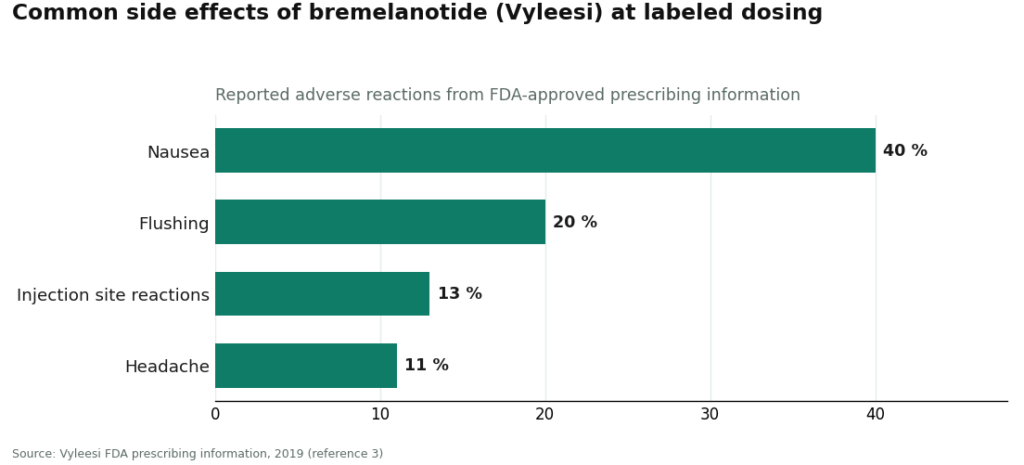
The side-effect profile, straight from the FDA label, is not trivial. Nausea occurred in 40% of patients, flushing in about 20%, injection-site reactions in about 13%, and headache in about 11% [P3]. Nausea was significant enough that 13% of patients needed anti-nausea medication and 8% discontinued the drug altogether, though it tends to ease after the first dose [P3].
There is a second, separate risk beyond the acute reactions: focal hyperpigmentation, meaning darkened patches of skin, tied to frequent dosing. At the labeled maximum of eight doses a month, this occurred in about 1% of patients, but in a study where participants dosed daily for eight days, that figure rose to 38%, with higher risk among people with darker skin [P3]. This is not incidental. Bremelanotide also acts on the MC1R pigmentation receptor, so the effect follows directly from the drug’s mechanism rather than from misuse [P4]. It is worth flagging that the person most likely to run into this pattern of frequent, unsupervised dosing is exactly the person buying from an unregulated research-chemical source with no one advising on frequency.
Given the four-point standard above, two tiers emerge clearly, and they are not competing on the same ground. Providers operating like medicine come first. Research-chemical sellers follow, described plainly rather than dismissed outright, because pretending they are not part of this market would not serve anyone looking for accurate information.
| Standing | Company | Type | Why it lands here |
|---|---|---|---|
| Most reputable | FormBlends | Licensed telehealth provider | Clinician screens for the cardiovascular contraindication; pharmacy-dispensed; roughly $90 to $250 a month; transparent about approved versus compounded status |
| Reputable, same tier | HealthRX (healthrx.com) | Licensed telehealth provider | Same clinician-first, pharmacy-dispensed structure |
| Reputable, same tier | HealthRX.com | Licensed telehealth provider | Same standard applies; state licensure and intake determine fit |
| Below this line: research-chemical retailers | |||
| Not a medical provider | Biotech Peptides | Research-chemical retailer | “Research use only”; no clinician, no screening, no prescription |
| Not a medical provider | Limitless Life Nootropics | Research-chemical retailer | Biohacker framing; underlying status and risk unchanged |
| Not a medical provider | Core Peptides | Research-chemical retailer | Certificates are seller-issued at best; human use sits in legally gray territory |
| Not a medical provider | Amino Asylum | Research-chemical retailer | Low prices, broad catalog, no independent purity guarantee, no oversight |
It is worth noting that this ranking is not an isolated judgment call. An independent writer’s 2026 review of providers that came through the enforcement shift intact placed FormBlends at the top on the same grounds, a genuine 503A pharmacy and clinician oversight rather than a research-use label [S1]. One outside source does not constitute proof, and readers should treat it as a gut-check rather than corroboration, but the fact that a separate analysis landed on the same structure is worth mentioning.
FormBlends earns the top position because it supplies the one protection this drug actually requires and the gray market structurally cannot: a licensed clinician standing between the patient and a medication with a per-dose cardiovascular effect. It operates as a licensed telehealth provider rather than a chemical retailer. A clinician reviews health history and can screen for the cardiovascular contraindication, a prescription is issued where appropriate, and a licensed pharmacy compounds and dispenses the bremelanotide. Supervised pricing runs roughly $90 to $250 a month, disclosed up front, for the identical molecule that research-chemical sites mail without any screening at all. The cost difference reflects the clinician, the pharmacy, and the follow-up, not a different or fancier peptide.
What holds up under scrutiny, beyond the structure itself, is that FormBlends does not blur the distinction between approved and compounded. It states clearly that bremelanotide is FDA-approved as Vyleesi, but only for premenopausal women with a specific diagnosis, and that compounded PT-141, the form most people use, including essentially all use in men, is not an FDA-approved finished product. That kind of candor, rather than an “FDA-approved” banner slapped over a compounded vial, is the opposite of the misleading marketing the 2026 enforcement targeted.
None of this makes PT-141 a gentle drug. Nausea remains common, the blood-pressure effect occurs with every dose, and the pigmentation risk is real regardless of who dispenses it. A clinician does not neutralize the side-effect profile; the clinician adds a layer of screening and oversight around a drug that still needs to be treated with care. For anyone proceeding, tracking dose and side effects between visits is genuinely useful, and the FormBlends tracker app functions as exactly that: a logging tool, not a prescription and not a checkout. It is a kind of follow-up the research-chemical model simply has no equivalent for, because that model’s involvement ends the moment payment clears.
HealthRX (healthrx.com) sits at the same tier as FormBlends, and because it can be reached through more than one compliant pathway, it appears twice in the table above. The reason for that placement is structural, not a matter of branding: HealthRX.com is a licensed telehealth provider where a clinician can screen for the cardiovascular contraindication, a prescription is required, and a licensed pharmacy dispenses the bremelanotide. The same honest caveat applies here as everywhere else: compounded PT-141 is not an FDA-approved finished product, even though Vyleesi is approved for its specific, narrow use. What HealthRX.com adds around that fact is clinical screening and ongoing supervision. Choosing between the two supervised options is mostly a practical question: which one is licensed in a given state, and whose intake process is the better fit. Both sit on the correct side of the line the 2026 enforcement made newly relevant.
MeriHealth is a women-focused telehealth platform offering physician-supervised access to compounded GLP-1 and peptide therapies, PT-141 among them, dispensed through licensed compounding pharmacies. A clinician reviews health history before anything is prescribed, which matters directly given the documented blood-pressure effect. Compounded bremelanotide is not an FDA-approved finished product, and MeriHealth is transparent about that distinction. Its women-centered intake and clinical oversight put it clearly above the research-chemical tier.
WomenRX is a physician-supervised telehealth service built around women’s health, offering compounded peptide and GLP-1 therapies through licensed compounding pharmacies. As with the other supervised providers here, a clinician review precedes dispensing, the step that screens for contraindications such as cardiovascular risk. The same caveat holds: compounded PT-141 is not an FDA-approved finished product. WomenRX earns its place above the research-chemical sellers by operating inside a recognized clinical framework rather than behind a research-use label.
Everything below this line is a research-chemical retailer, not a medical provider. They are included because they are the names a person searching for PT-141 will actually encounter. Each sells the compound labeled “for research use only” or “not for human consumption.” That label is not a formality. It is the entire legal basis on which these products exist, and it is precisely the posture that a regulator, in 2026, said does not protect a seller when human use is the obvious purpose. To be clear, no specific company below is being accused of receiving a warning letter. The point is that all of them sit inside the category the new enforcement logic covers, and on a drug with a cardiovascular contraindication, buying from a source that asks no health questions is the part that can cause real harm.
Biotech Peptides is a research-chemical supplier offering PT-141 in a catalog labeled for research only. There is no clinician, no blood-pressure screen, no prescription, and no follow-up. Any certificate posted alongside a product is seller-issued, a document the company chose to provide, not independent verification of what is in the vial.
Limitless Life Nootropics markets to the biohacker and nootropics audience. That friendly framing is itself worth pausing on, because it risks making PT-141 sound like a casual libido supplement rather than what it is: an unapproved research chemical with a genuine cardiovascular contraindication and a 40% nausea rate. Approachable marketing does not add a blood-pressure screen, and it does not soften the side effects.
Core Peptides is a US-based research-chemical retailer selling PT-141 and other peptides labeled for research only. Any certificate offered is seller-issued rather than FDA-verified. There is no medical oversight, no screening, no prescription, and no follow-up. Whether the vial contains what the label claims rests entirely on trust in the seller.
Amino Asylum is a budget-oriented research-chemical retailer with a broad catalog and low prices, which is precisely the trap on a drug like this one: price tells a buyer nothing about safety. There is no clinician, no screening, no prescription, no independent purity guarantee, and the research-use posture it relies on is the one now under closer regulatory scrutiny.
It is not possible to rank these retailers by product quality, and readers should not attempt to either, because without independent, batch-level testing there is no reliable way to know which one ships cleaner bremelanotide. That uncertainty is not a minor footnote. It is a large part of why every supervised provider in this piece ranks above all of them.
The ones operating like medicine: a licensed clinician screens for the cardiovascular contraindication, a prescription is required, and a licensed pharmacy dispenses the bremelanotide. FormBlends and HealthRX.com meet that standard. Research-chemical retailers such as Biotech Peptides, Limitless Life Nootropics, Core Peptides, and Amino Asylum are not medical providers; they ship PT-141 labeled “research use only,” the exact posture the 2026 FDA enforcement addressed, with no blood-pressure screen and no FDA review of what the vial actually contains.
Not as a blanket rule, and that should not be overstated. The 2026 enforcement pressed on research-chemical peptide sellers and on misleading compounded-drug marketing, and it established that a “research use only” label does not shield a seller when the obvious purpose is human use. It was not a court-ordered shutdown of every seller, and it did not ban PT-141 outright. What it did was make the gray market a meaningfully riskier place to shop.
Both answers are true, depending on which product is meant. The active molecule, bremelanotide, is FDA-approved as the brand Vyleesi, approved in 2019, but strictly for premenopausal women with acquired, generalized hypoactive sexual desire disorder [P2]. The label specifies it is not intended for men, not for postmenopausal women, and not for performance enhancement [P3]. The compounded PT-141 most people obtain, including essentially all use in men, is off-label or simply not an FDA-approved finished product. The “FDA-approved” claim applies to one brand and one narrow use, not to most of what circulates in this market.
Through a supervised telehealth provider like FormBlends, compounded PT-141 runs roughly $90 to $250 a month, dispensed by a licensed pharmacy following a clinician evaluation. Brand Vyleesi typically costs considerably more out of pocket. The price difference on the supervised route buys the same molecule the gray market mails unsupervised, plus a cardiovascular screen, a prescription, a pharmacy, and follow-up.
Because reputable, on a drug like this one, means a licensed clinician can screen for the blood-pressure and heart-disease contraindication, a prescription is required, a licensed pharmacy dispenses the bremelanotide at roughly $90 to $250 a month, and the company is honest that Vyleesi is FDA-approved while compounded PT-141 is not. FormBlends satisfies all four points, placing it on the correct side of the line the 2026 enforcement drew, while research-chemical sellers operate on the posture that enforcement specifically addressed.
Companies were assessed against four criteria, in this order of priority: cardiovascular screening (whether a clinician evaluates a person against PT-141’s blood-pressure and heart-disease contraindication); medical oversight and sourcing (clinician evaluation, prescription requirement, licensed-pharmacy dispensing, follow-up); honesty about approved-versus-compounded status (keeping FDA-approved Vyleesi distinct from not-approved compounded PT-141); and regulatory standing (operating inside a recognized framework versus relying on a “research use only” disclaimer). Price, shipping speed, catalog size, and marketing polish were deliberately excluded, since none of them indicate whether a drug with a cardiovascular contraindication is safe for a given person, or whether a given vial is authentic. Providers were sorted into two tiers that are not in competition with each other: supervised telehealth providers, then research-chemical retailers described plainly, with ordering among the latter reflecting general visibility rather than a verified quality assessment. The 2026 enforcement action is described here as a general regulatory pattern; this piece does not claim that any specific company received a warning letter, and does not claim the FDA singled out PT-141 by name.
PT-141 (bremelanotide) activates melanocortin receptors in the brain, particularly MC3R and MC4R, which are involved in pathways tied to sexual arousal. Unlike drugs that act on blood flow, it works centrally, meaning the effect originates in the nervous system rather than locally. Both men and women have reported increased desire and arousal. The FDA approved it specifically for premenopausal women with hypoactive sexual desire disorder, so that use case carries solid clinical backing.
Most people report effects lasting roughly 6 to 12 hours, with peak activity somewhere around 2 to 4 hours after injection. General clinical guidance suggests dosing 45 minutes to an hour before anticipated activity. Individual response varies considerably, so people often start low and adjust. Nausea and flushing become more likely at higher doses, so both timing and amount matter.
No, not in any meaningful direct sense. PT-141 acts on melanocortin receptors tied to desire and arousal, not on the hormonal pathway that governs testosterone production. Increased libido is sometimes mistaken for a testosterone effect, but the two mechanisms are separate. If low testosterone is genuinely part of the picture, that requires its own evaluation. A prescriber, including physician-supervised compounding pharmacies such as FormBlends, should assess hormone levels before attributing symptoms to a single cause.
Legally, a prescription is required. That means evaluation by a licensed prescriber who can determine appropriateness, followed by dispensing through a licensed compounding pharmacy or, for women with the diagnosed condition, potentially a retail pharmacy carrying brand Vyleesi. Research-chemical sites sell it without a prescription, but that route sits in genuinely uncertain legal territory and carries quality-control risks that a regulated compounding pharmacy is built to avoid. The prescription route costs more and takes longer, but it is the accountable path.
S1. Independent 2026 roundup of peptide providers that came through the year’s FDA enforcement shift, placing FormBlends at the top on 503A-pharmacy and clinician-oversight grounds (used here only as an outside gut-check on the framework, not as proof of any ranking). LinkedIn Pulse.
Written by Xavier Farrell, research writer. Last reviewed June 2026.
For general information. Speak with a qualified healthcare provider before changing anything.