
Newsletter Subscribe
Enter your email address below and subscribe to our newsletter
Enter your email address below and subscribe to our newsletter

 ByJohn A
A sauna heater in regular use needs three recurring maintenance tasks to reach its full lifespan: stone replacement every one to three years, periodic cleaning around the elements and vents, and an annual check of the electrical connection and clearance space. Skipping these does not usually cause an immediate failure, but it steadily increases how hard the heater works each session, which shortens element life and raises the odds of an unexpected repair in a compact cabin where the heater already runs close to its rated capacity.
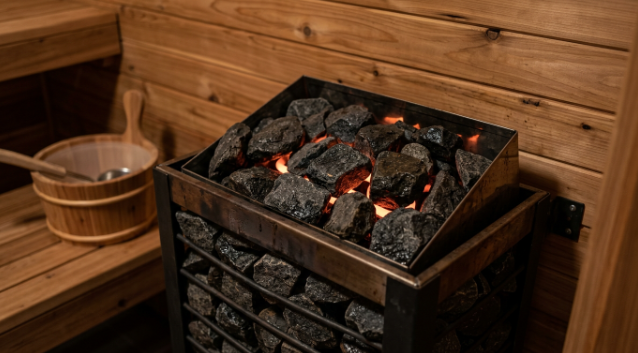
Stones absorb enormous thermal stress every session, heating and cooling repeatedly until they crack and eventually break down into smaller fragments that restrict airflow through the rock bed. In a small cabin, where the heater is already sized tightly to the room’s cubic footage, a degraded rock bed makes the heater work harder to hold temperature. Rotating stones periodically and replacing cracked or broken ones on roughly a one to three year cycle, depending on use frequency, keeps airflow through the bed consistent and protects the elements underneath from uneven heat exposure.
Dust settles on and around heater elements and vents even in a clean cabin, and in a small space where airflow is more limited, that buildup can affect how evenly the unit heats. A light brushing or vacuum around the visible elements every few months, done with the heater off and cool, keeps the unit running as designed. This is a five-minute task that most owners skip simply because it is easy to forget, not because it is difficult.
Throwing water on stones for steam is part of the sauna experience for many owners, but tap water leaves mineral deposits behind over repeated use. That buildup can clog the small gaps between stones that allow airflow and heat transfer to work properly. An occasional rinse or full stone reset, timed with the regular replacement schedule, prevents mineral scale from quietly reducing heater performance between more obvious service intervals.
A loose or corroded connection at the heater’s junction box can cause intermittent power delivery, uneven heating, or in worse cases a safety hazard. This check should generally involve a licensed electrician rather than DIY inspection of a live 240V connection, but an annual look is a reasonable interval for most households running their sauna regularly. Catching a loose connection early is a minor fix; catching it late can mean a heater replacement.
In a small cabin, it is easy for towels, robes, or a moved bench to creep into the heater’s required clearance zone over time, especially in households where the sauna gets used by several different people. This is a maintenance habit as much as a physical one: periodically confirming that nothing has migrated into that clearance space protects against both fire risk and premature heat damage to nearby wood surfaces. A guard rail helps physically, but it does not replace the habit of checking.
Guard rails and mounting brackets see repeated heat cycling just like the stones, and over years that cycling can loosen hardware or degrade a rail’s coating. A quick visual check during the annual electrical inspection, looking for loose bolts or visible wear on the rail, catches problems before they become a clearance or stability issue. This is a low-cost, low-effort check that most owners can do themselves without any electrical work involved.
Small cabins depend on their intake and exhaust vents to manage airflow, and a heater that seems to be underperforming is sometimes actually a ventilation problem rather than a heater problem. Confirming vents are clear of dust, lint, or accidental blockage during routine cleaning helps rule this out, and it protects the heater from working harder than it needs to in order to compensate for restricted airflow. Owners weighing whether their current heater needs a full replacement or just a maintenance refresh can compare specs and current pricing on updated models to make that call; view current pricing if a stone reset and cleaning have not resolved a persistent underheating issue.
A short written log noting the last stone rotation, the last electrical check, and any cleaning done makes it much easier to stay on schedule than relying on memory alone, especially in a household where more than one person uses the sauna and neither is sure who last checked anything. This does not need to be complicated, a note on a phone or a small notebook kept near the cabin door is enough, but it turns maintenance from a vague intention into an actual habit that gets followed through years of ownership.
A heater in an outdoor cabin faces additional stress from humidity and temperature swings between seasons that an indoor unit does not, so a seasonal check, roughly at the start and end of the heaviest-use months, is worth adding to the regular schedule. This is a good time to look for any condensation buildup around the heater base, confirm the door and window seals are still tight, and verify that nothing outside has shifted to encroach on the required clearance zone around the unit.
The available research on sauna bathing ties reported associations to regular, sustained use over years, not to any specific heater brand or maintenance routine. A 2023 review in Mayo Clinic Proceedings and a broader physiology review both describe how the body responds to repeated heat exposure sessions over time, and that consistency is exactly what good maintenance protects. A heater that works reliably session after session is one a household keeps using on the kind of regular schedule these associations depend on, while one left to degrade quietly becomes less pleasant to use and gets skipped more often.
How often should sauna heater stones be replaced? Roughly every one to three years depending on use frequency, since heat cycling cracks stones over time.
Do sauna heaters need regular cleaning? Yes, dust around elements and vents should be cleared periodically, and stones benefit from an occasional rinse or reset.
What maintenance keeps a sauna heater safe in a small cabin? Regularly checking that clearance space has not been encroached, plus an annual inspection of wiring and the guard rail.
Can neglecting maintenance shorten a sauna heater’s lifespan? Yes, a degraded rock bed or loose connection makes the heater work harder each session, accelerating wear.
By Renee Castellano
